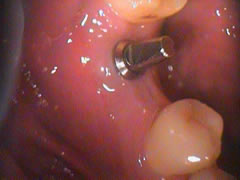
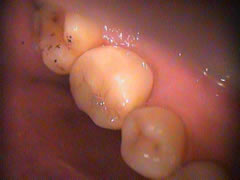
Implants can also sometimes be used to replace
more extensive tooth loss.(See Image 1)
The techniques we use are usually single stage
surgery, with the definitive restoration being
placed from 4 weeks to 4 months after surgery
“Even now, it is unfortunately sometimes
impossible to save teeth. A common reason
for tooth loss in an otherwise well maintained
situation is root fracture” (See Image 2)
It is now of course possible to place dental
implants at the time of tooth extraction, and in
some circumstances to place load on implants at
the time of surgery. Our practice
currently maintains a slightly more cautious
protocol, where even in ideal conditions we do not
find the potential risk for these techniques
outweigh the potential extra risk of early
failure.
Techniques to place implants can be very minimally
invasive. Sometimes this can mean the
insertion of implant without any surgical cuts or
stitches. (See Image 3)
Usually, once the implant is inserted, the
addition of abutments in order to be able to place
the replacement tooth is non-invasive. (See Image
4)
Dental implants can also be used to stabilise
existing dentures /prostheses. This means
that even if teeth were lost some years ago, and
there has been a removable denture that is
increasingly loose and unstable, the
situation can be stabilised by the placement of a
few implants in order to anchor / retain the
prosthesis.